
Learn Something
Your "Eco" Product Might Need a Better Explanation
Recycled, recyclable, renewable, biodegradable... they don't all mean the same thing. Here's how to talk about materials without the greenwashing headache.
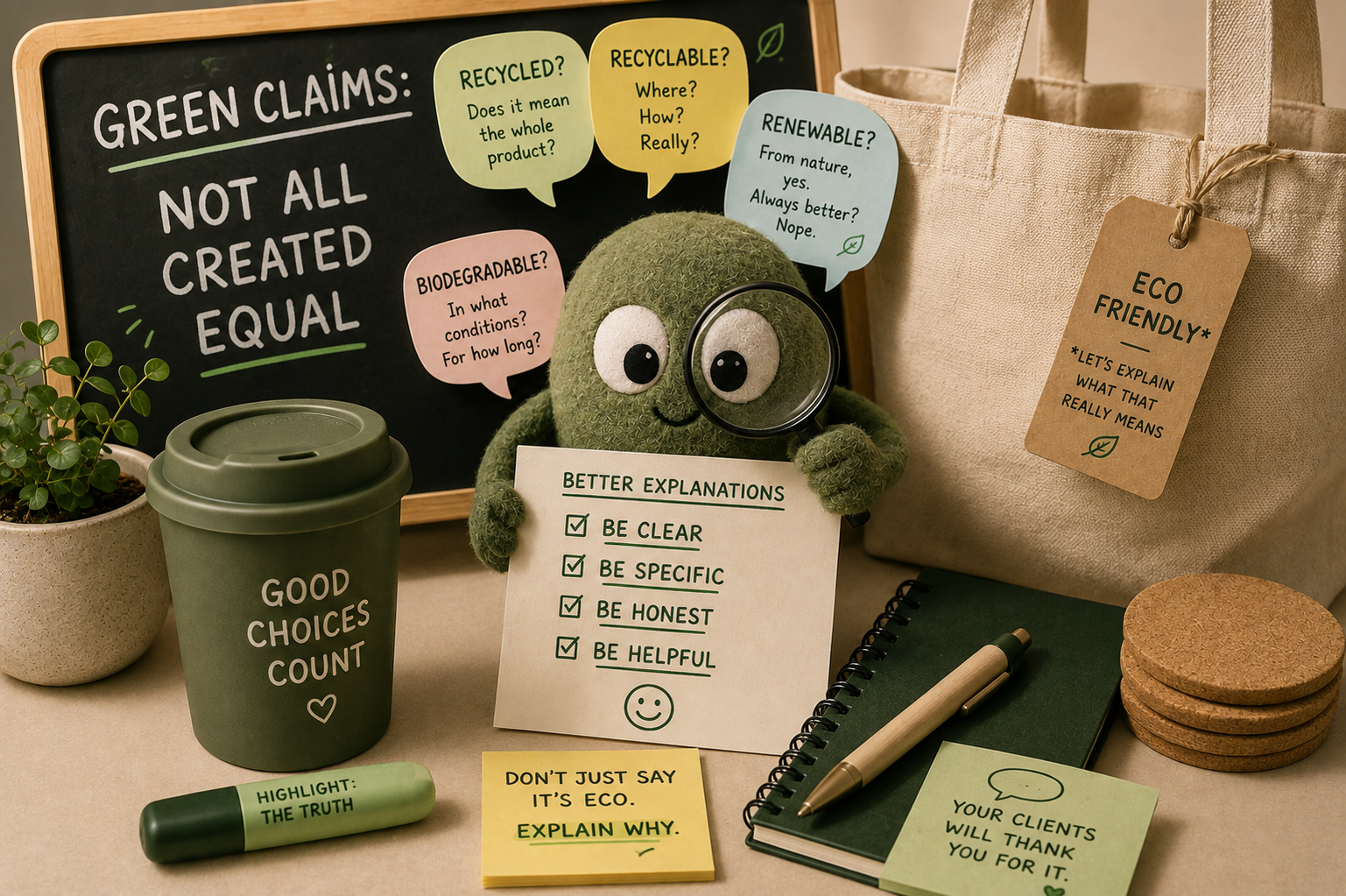
Recycled. Recyclable. Renewable. Biodegradable. Compostable.
Throw in natural, reusable and made from plants and suddenly you've got enough green vocabulary to cover a reusable tote bag.
The problem? These words don't all mean the same thing.
And when we're talking about promotional products, using the wrong word — or expecting one word to tell the whole sustainability story — can create more confusion than clarity.
So let's sort out a few of the usual suspects. No sustainability dictionary required.
First, can we talk about the word "eco"?
"Eco" is useful shorthand in everyday conversation. But by itself, it doesn't tell us very much about a product.
Does it contain recycled material? Is it designed to be reused? Is the material renewable? Does it carry a relevant certification? Has packaging been reduced? Is there information available about its carbon footprint?
Those are all very different things.
So instead of stopping at "this is an eco product", a much more useful conversation is: "What specifically makes this product a more considered option?"
That's where things get interesting.
Recycled
Recycled generally tells us something about where a material has come from.
In simple terms, material that would otherwise have been discarded has been processed and used again as an input into a product or material.
You might come across promotional products containing recycled polyester, recycled plastic, recycled aluminium, recycled stainless steel, recycled paper or other recycled materials.
But here's the important bit: "contains recycled material" does not automatically mean "the entire product is made from recycled material."
A product can contain multiple materials and components, and recycled content may apply to only part of it.
Where a percentage or component-specific claim is available, that information gives you a much clearer picture.
Wait... what does that mean?
Recycled polyethylene terephthalate
PET is a type of plastic commonly used in products such as beverage bottles. rPET refers to PET material made using recycled PET. Depending on the product, it can be used in everything from bags and textiles to accessories and other promotional merchandise.
There. One less acronym to pretend you already knew.
Explore the Material GuideRecyclable
Here's where two words that sound suspiciously similar start causing trouble.
Recycled and recyclable describe different things. Recycled relates to material that has already been recovered and used again. Recyclable relates to whether a material or product may be capable of being collected and processed for recycling after use.
And even then, there's an important catch. Whether something can actually be recycled may depend on the materials it contains, how those materials are combined, coatings, adhesives or additional components, whether the product can be separated, and the recycling infrastructure available where the product is disposed of.
So a product can contain recycled material without necessarily being practically recyclable at the end of its life.
Which brings us neatly to...
Quick myth buster
"Recycled means recyclable."
Not necessarily. A product can contain recycled material without being recyclable at the end of its useful life. Material combinations, coatings, components and local recycling systems can all affect whether it can actually be recycled.
Explore the Material GuideThe words sound similar. The claims aren't.
Renewable
Renewable describes a resource that can naturally replenish over time.
Materials derived from plants are often discussed in this context because plants can grow again. Bamboo, cork and certain plant fibres are examples you may come across in promotional merchandise.
But — and you probably knew there was a "but" coming — renewable doesn't automatically mean impact-free.
How a raw material is grown, harvested, processed, manufactured, transported and combined with other materials can all form part of the wider picture.
The word renewable tells us something useful. It just doesn't tell us everything.
Biodegradable
This one gets thrown around a lot.
Biodegradable generally describes a material that can be broken down by microorganisms under suitable conditions.
The important words there are: under suitable conditions.
Different materials can require different environments and different amounts of time to break down.
Simply seeing the word biodegradable doesn't necessarily tell you where the product should be disposed of, how quickly it will break down or what conditions are required.
Those details matter.
Compostable
Compostable and biodegradable are related ideas, but they shouldn't simply be used interchangeably.
Compostability relates to material breaking down under composting conditions. Some materials may require controlled or industrial composting conditions rather than an ordinary home compost system.
So if a product or packaging carries a compostability claim, look for the specific information or certification supporting that claim and the conditions that apply.
"Compostable" isn't an instruction to throw something into the garden and hope for the best.
Reusable
This might sound like the easiest one. If something can be used more than once, it's reusable. Easy.
Except the important question isn't only whether something can be reused. It's whether somebody will reuse it.
A beautifully designed bottle that becomes someone's everyday bottle has a very different use story from 500 reusable items that nobody wanted in the first place.
That's why product usefulness, quality and relevance matter.
Promotional merchandise shouldn't just survive long enough to be reusable.
It should be useful enough to deserve another use.
Natural
"Natural" sounds lovely. Trees. Sunshine. Probably a bird singing somewhere.
But as a product claim, it needs context.
A natural material tells you something about the material's origin. It doesn't automatically tell you how it was grown, extracted, processed, transported, manufactured or combined with other components.
Again, the word isn't necessarily the problem.
Expecting one word to explain the whole product is the problem.
So what should we say instead?
This is actually the easy part. Be specific.
Instead of "made from sustainable materials", say what you actually know about the material.
Instead of "eco-friendly bottle", explain the relevant product attribute — for example, the material composition or confirmed recycled content where that information is available.
Instead of "good for the planet"... don't. That's an enormous claim for a promotional mug to carry on its shoulders.
Specific information is usually more useful than sweeping environmental language.
The product page should do some of the heavy lifting
This is one of the reasons we're building more structured sustainability information into Ecosource.
Where the information is available, individual product pages can help show things such as material composition, recycled-material information, sustainability attributes, relevant certifications, branding options, product specifications and carbon information where available.
That gives resellers something more useful than a green icon and the word eco.
It gives you information you can actually discuss with your client.
Better explanations make better claims
None of this means you need to turn every promotional product quote into an environmental thesis. Quite the opposite.
Good sustainability communication can be remarkably simple.
Say what you know. Explain what the claim refers to.
Use supporting information where it's available. Don't make the product promise more than the evidence supports.
That's it.
"Recycled" can be useful information. "Renewable" can be useful information. "Compostable" can be useful information. "Reusable" can be useful information.
We just need to stop expecting one little green word to tell the entire story.
The takeaway
A better sustainability conversation doesn't necessarily need more jargon. Usually, it needs better explanations.
The next time someone tells you a product is "eco", try asking: what do we actually mean by that?
You might end up with a much more useful answer.
Want to dig a little deeper?
Material Guide
Understand more about the materials used across the Ecosource range.
Explore MaterialsCertifications
Learn what different certifications and standards represent.
Explore CertificationsSustainability
How Ecosource approaches materials, certifications, product attributes and impact information.
Explore SustainabilityProducts
Browse the Ecosource range with material, certification and carbon information.
Explore Products