Standards & Certifications
FSC, GRS, RCS... Who Invited All These Acronyms?
A plain-English introduction to some of the certifications you're likely to come across when sourcing promotional merchandise.
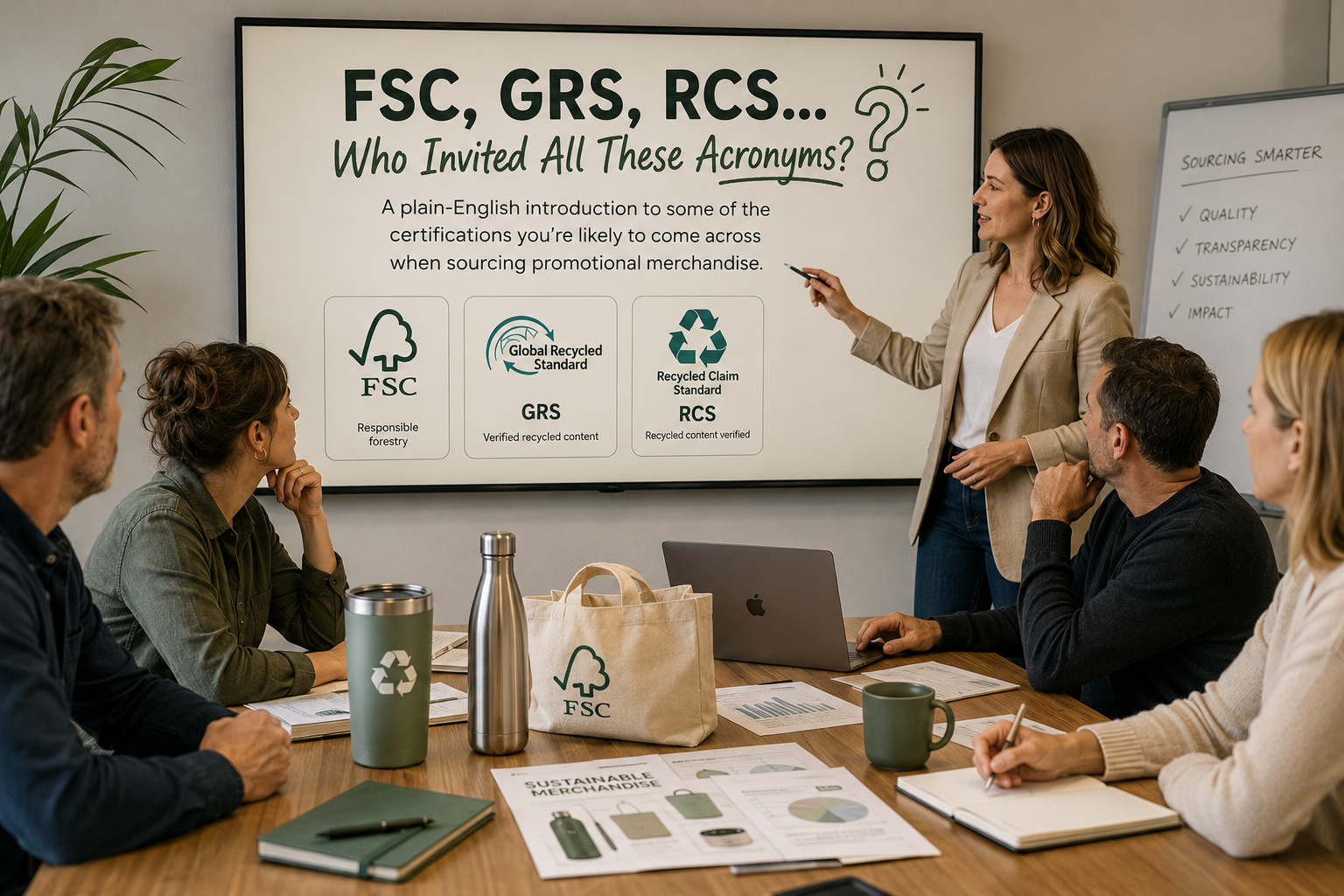
FSC. GRS. RCS.
Sometimes sourcing a promotional product feels less like shopping and more like somebody handed you a bowl of alphabet soup.
And just when you think you've worked out what one acronym means, another one appears.
Certifications and standards can be incredibly useful. They can provide additional information about materials, sourcing, recycled content, supply chains and manufacturing requirements.
But only if we understand what they're actually telling us.
So let's translate a few of the names you're likely to come across in promotional merchandise into normal human language. No exam at the end. Promise.
First: what does a certification actually tell me?
This is important, because it's tempting to see a certification logo and think: great, sustainable product, job done.
Not quite.
Different certifications look at different things. One might relate to the source of a forest-based material. Another might help verify recycled content. Another may include requirements relating to parts of the processing or supply chain.
A certification therefore shouldn't be treated as a universal green tick covering every environmental and social aspect of a product.
The better question is: what exactly does this certification cover?
That's where those little acronyms start becoming useful.
FSC — Forest Stewardship Council
FSC relates to forest-based materials and responsible forest management.
You're most likely to encounter FSC-related claims on products or packaging involving materials such as paper, cardboard, wood or other forest-derived materials.
Depending on the specific FSC claim or label, the material may come from FSC-certified forests, recycled sources and/or other controlled sources.
The important point is that FSC is about forest-based materials and their chain of custody — not a blanket sustainability certification for everything that happens to the finished product.
So if a notebook contains FSC-certified paper, that's useful information about the paper. It doesn't automatically tell you everything about the cover, binding, branding, packaging, transport or every other component.
Context matters.
Wait... what does that mean?
Tracking certified material through the supply chain
A system for tracking certified material through stages of the supply chain. In simple terms, it helps connect material from an eligible source through processing and trading to the point where a certification claim is made.
Basically: not just "trust us, it's certified."
Explore the Certifications GuideGRS — Global Recycled Standard
GRS is associated with products containing recycled material and includes requirements around recycled-content verification and chain of custody.
The standard also includes additional requirements relating to areas such as processing practices and certain social, environmental and chemical considerations within its scope.
That's one reason you'll often see GRS mentioned when looking at products made with recycled textiles or other recycled materials.
But there's an important distinction: a GRS claim should tell you something specific and verifiable. It shouldn't become shorthand for "this entire product has no environmental impact."
No certification can make that promise.
RCS — Recycled Claim Standard
RCS focuses on verifying recycled material and tracking it through the supply chain.
In plain English, it helps provide greater confidence that recycled content being claimed is actually present and appropriately tracked.
RCS and GRS are related, but they are not simply two names for exactly the same thing. GRS includes broader requirements within its scope, while RCS is more specifically focused on recycled material verification and chain of custody.
Which means seeing either acronym is only the beginning of the conversation. You still need to understand the claim attached to the particular product.
Okay... so GRS and RCS both involve recycled material?
Yes. Welcome back to the alphabet soup.
The easiest way to think about it is this. RCS primarily helps verify and track recycled material. GRS also addresses recycled content and chain of custody, with additional requirements within the standard.
That doesn't mean one acronym should automatically be treated as "better" than the other.
What matters is what you're trying to understand about the product, and what specific certification or claim is actually supported.
Quick myth buster
"Certified means the whole product is sustainable."
A certification usually relates to defined materials, processes, claims or parts of a supply chain. It should be understood according to its actual scope rather than treated as a universal sustainability rating for the entire product.
Explore the Certifications GuideA logo can tell you something useful. It doesn't tell you everything.
What should I look for when I see a certification?
Rather than simply spotting a logo and moving on, ask a few questions.
1. What does the certification cover? Is it about recycled content? Forest-based materials? A manufacturing process? Chain of custody? Knowing the scope is much more useful than knowing the acronym.
2. What part of the product does it apply to? A certification may relate to a particular material or component rather than every part of the finished item.
3. What claim is actually being made? Look at the wording associated with the certification rather than making assumptions based on the logo alone.
4. Is supporting information available? Where documentation, certification details or supplier information is available, use it.
5. Am I describing it accurately to my client? This is perhaps the most important one. If the information says a particular component contains certified recycled material, don't quietly upgrade that into "the whole product is certified sustainable." That's how useful information turns into an unsupported claim.
And what about all the other acronyms?
There are plenty.
Depending on the products, materials and suppliers you're working with, you may encounter certifications and standards relating to textiles, forestry, recycled materials, organic materials, chemical requirements, product safety and other areas.
We're not going to cram every one of them into this article. You have other things to do today.
Instead, the Ecosource Certifications Guide is designed to give you somewhere to look when another mysterious set of letters appears on a product page.
Certifications are evidence — not decoration
This is probably the biggest takeaway.
Certification logos shouldn't simply be decorative badges that make a product page look greener. Their value comes from the information and verification behind them.
When they're used properly, certifications can help buyers understand particular aspects of materials and supply chains, and communicate those attributes more accurately.
Certifications are evidence — not decoration.
That's considerably more useful than simply saying "it's eco."
What Ecosource is trying to do differently
Where certification information is available for a product, we want to make it easier for resellers to see and understand.
That means connecting relevant certification information to individual products where supported, while also providing resources that explain what those certifications actually mean.
We're not trying to turn every reseller into a certification auditor. We're trying to make the information behind the product easier to navigate.
Because if you're going to show a certification to your client, you should be able to answer the next question: "What does that actually mean?"
And preferably without opening twelve browser tabs.
The takeaway
FSC, GRS and RCS aren't magic sustainability stamps. They're tools that can help tell us something specific about a product, material or supply chain.
The trick isn't memorising every acronym. It's learning to ask: what does this certification actually cover?
Once you start there, the alphabet soup becomes considerably easier to swallow.
Want to dig a little deeper?
Certifications
Learn what different certifications and standards represent.
Explore CertificationsMaterial Guide
Understand more about the materials used across the Ecosource range.
Explore MaterialsSustainability
How Ecosource approaches materials, certifications, product attributes and impact information.
Explore SustainabilityProducts
Browse the Ecosource range with material, certification and carbon information.
Explore Products